Description
Pow(x, n)
Implement pow(x, n), which calculates x raised to the power n (i.e., xn).
Example 1:
Input: x = 2.00000, n = 10
Output: 1024.00000
Example 2:
Input: x = 2.10000, n = 3
Output: 9.26100
Example 3:
Input: x = 2.00000, n = -2
Output: 0.25000
Explanation: 2-2 = 1/22 = 1/4 = 0.25
Constraints:
-100.0 < x < 100.0-231 <= n <= 231-1nis an integer.- Either
xis not zero orn > 0. -104 <= xn <= 104
Approach
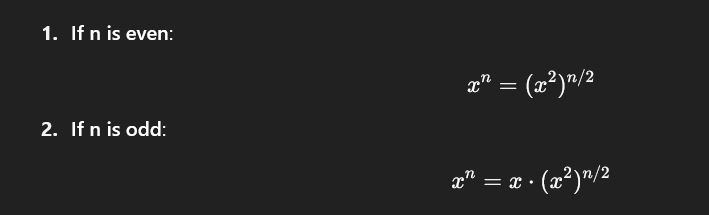
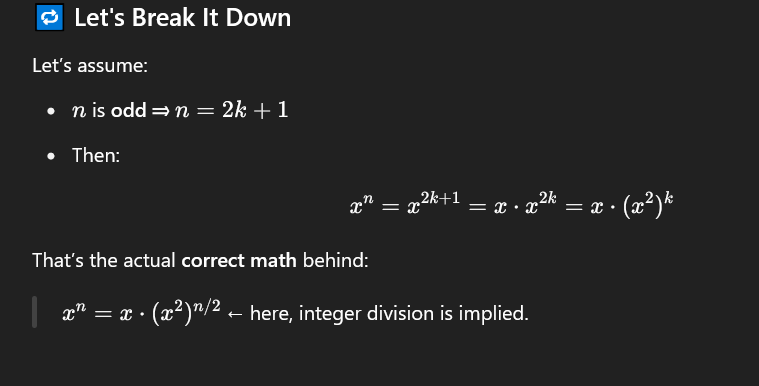
- We have two conditions one with odd and one with even
class Solution {
    public double myPow(double x, int n) {
        long N = n;
        if (n < 0) {
            x = 1 / x;
            N = -N;
        }
        double res = 1;
        while (N > 0) {
            if (N % 2 == 1) {
                res *= x;
            }

            x *= x;
            N /= 2;
        }

        return res;
    }
}
1. Brute Force Solution
Intuition:
Multiply by itself times. If is negative, invert () and convert to positive.
Complexity:
- Time Complexity: — Multiplies times. (Causes TLE on LeetCode)
- Space Complexity:
class Solution {
    public double myPow(double x, int n) {
        long N = n; // Cast to long to handle Integer.MIN_VALUE overflow
        if (N < 0) {
            x = 1 / x;
            N = -N;
        }

        double ans = 1.0;
        for (long i = 0; i < N; i++) {
            ans = ans * x;
        }
        return ans;
    }
}
2. Most Optimized Solution (Binary Exponentiation)
Intuition:
Instead of multiplying one by one, halve the exponent at every step:
- If exponent is odd, multiply the current base into the result
res. - Square the base () and halve the power () in every iteration.
Key Rule to Remember:
“If power is odd, extract one into
res. Always square the base and half the power.”
Complexity:
- Time Complexity: — Divides by 2 in every iteration.
- Space Complexity: — Iterative approach uses extra memory.
class Solution {
    public double myPow(double x, int n) {
        long N = n; // Handles Integer.MIN_VALUE (-2^31) edge case safely
        if (N < 0) {
            x = 1 / x;
            N = -N;
        }

        double res = 1.0;
        while (N > 0) {
            // If power is odd, accumulate x into result
            if (N % 2 == 1) {
                res *= x;
            }

            // Square the base & halve the exponent
            x *= x;
            N /= 2;
        }

        return res;
    }
}
In your Java solution for Pow(x, n), long N is used to prevent integer overflow when is negative.
**1. The Problem with Integer.MIN_VALUE**
In Java, a standard 32-bit signed int ranges from:
- Minimum value:
- Maximum value:
Notice that the absolute value of the minimum integer () is greater than the maximum positive integer ().
2. What happens if you don’t use long?
If and you try to convert it to positive using a standard int:
int N = n;
if (n < 0) {
    N = -N; // Overflow! -(-2147483648) exceeds Integer.MAX_VALUE
}
Because of integer overflow in Java, -(-2147483648) wraps around and remains -2147483648. As a result, the while (N > 0) loop condition immediately evaluates to false, returning 1 instead of computing the correct answer.
3. How long Fixes It
By storing in a 64-bit long variable (long N = n;), the variable can easily represent values up to . Negating (N = -N;) safely converts to without any overflow.