Description
There is an undirected graph with n nodes, where each node is numbered between 0 and n - 1. You are given a 2D array graph, where graph[u] is an array of nodes that node u is adjacent to. More formally, for each v in graph[u], there is an undirected edge between node u and node v. The graph has the following properties:
- There are no self-edges (
graph[u]does not containu). - There are no parallel edges (
graph[u]does not contain duplicate values). - If
vis ingraph[u], thenuis ingraph[v](the graph is undirected). - The graph may not be connected, meaning there may be two nodes
uandvsuch that there is no path between them.
A graph is bipartite if the nodes can be partitioned into two independent sets A and B such that every edge in the graph connects a node in set A and a node in set B.
Return true if and only if it is bipartite.
Example 1:
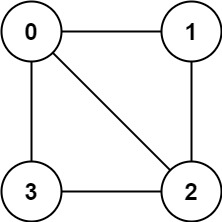
Input: graph = [[1,2,3],[0,2],[0,1,3],[0,2]]
Output: false
Explanation: There is no way to partition the nodes into two independent sets such that every edge connects a node in one and a node in the other.
Example 2:

Input: graph = [[1,3],[0,2],[1,3],[0,2]]
Output: true
Explanation: We can partition the nodes into two sets: {0, 2} and {1, 3}.
Constraints:
graph.length == n1 <= n <= 1000 <= graph[u].length < n0 <= graph[u][i] <= n - 1graph[u]does not containu.- All the values of
graph[u]are unique. - If
graph[u]containsv, thengraph[v]containsu.
Primary Approach: BFS 2-Coloring ( Time, Space)
Intuition
A graph is bipartite if its nodes can be divided into two sets such that every edge connects a node in set A to a node in set B. Equivalently, a graph is bipartite if and only if it can be colored using 2 colors (e.g., 1 and -1) without any two adjacent nodes sharing the same color:
- Maintain an array
color[]of size initialized to0(uncolored). - Loop through all nodes to to handle disconnected graph components.
- For any uncolored node, assign it
color = 1and push it to aQueue. - Poll a node and inspect its adjacent neighbors:
- If a neighbor is uncolored (
color[neighbor] == 0), assign it the opposite color (-color[curr]) and push it into the queue. - If a neighbor is already colored with the same color as
curr, a conflict exists—returnfalse.
- If a neighbor is uncolored (
import java.util.ArrayDeque;
import java.util.Queue;

class Solution {
    public boolean isBipartite(int[][] graph) {
        int n = graph.length;
        int[] color = new int[n]; // 0: uncolored, 1: Color A, -1: Color B

        for (int i = 0; i < n; i++) {
            if (color[i] != 0) continue; // Skip already colored components

            Queue<Integer> queue = new ArrayDeque<>();
            queue.add(i);
            color[i] = 1; // Assign initial color

            while (!queue.isEmpty()) {
                int curr = queue.poll();

                for (int neighbor : graph[curr]) {
                    if (color[neighbor] == 0) {
                        // Assign opposite color to neighbor
                        color[neighbor] = -color[curr];
                        queue.add(neighbor);
                    } else if (color[neighbor] == color[curr]) {
                        // Conflict: adjacent nodes have the same color
                        return false;
                    }
                }
            }
        }

        return true;
    }
}
Complexity
- Time Complexity: — Every vertex and edge is processed once.
- Space Complexity: —
color[]array and BFS queue take memory.
Alternative Approach: DFS 2-Coloring ( Time, Space)
Intuition
Perform recursive Depth-First Search to color adjacent nodes with alternating colors (1 and -1):
- For each node , if uncolored, invoke
dfs(i, 1). - Inside DFS, set
color[node] = currentColor. - For each neighbor:
- If uncolored, recursively call
dfs(neighbor, -currentColor). If it returnsfalse, propagatefalseup. - If colored and matches
currentColor, returnfalse.
- If uncolored, recursively call
class Solution {
    public boolean isBipartite(int[][] graph) {
        int n = graph.length;
        int[] color = new int[n]; // 0: uncolored, 1: Color A, -1: Color B

        for (int i = 0; i < n; i++) {
            if (color[i] == 0) {
                if (!dfs(i, 1, color, graph)) {
                    return false;
                }
            }
        }

        return true;
    }

    private boolean dfs(int node, int currentColor, int[] color, int[][] graph) {
        color[node] = currentColor;

        for (int neighbor : graph[node]) {
            if (color[neighbor] == 0) {
                // Color neighbor with opposite color
                if (!dfs(neighbor, -currentColor, color, graph)) {
                    return false;
                }
            } else if (color[neighbor] == currentColor) {
                // Color conflict detected
                return false;
            }
        }

        return true;
    }
}
Complexity
- Time Complexity: — Visits each node and edge once across all components.
- Space Complexity: — space for the
color[]array and recursive stack depth.
The Graph 2-Coloring approach works on a simple principle: Can we assign one of two colors (e.g., Red and Blue) to every node such that no two connected nodes share the same color?
If yes, the graph is Bipartite; if a conflict arises, it is Not Bipartite.
Step-by-Step Mechanism
- State Tracking: Use an array initialized to
0(Uncolored). Use1for Red and-1for Blue. - Start Traversal (BFS/DFS): Pick an uncolored node, color it
1(Red), and inspect its neighbors. - Neighbor Checks: For every neighbor of the current node:
- If Uncolored (
0): Assign it the opposite color (-color[curr]) and push it to the queue/DFS stack. - If Already Colored:
- Opposite Color: Valid! Continue traversing.
- Same Color: Conflict! Two adjacent nodes share the same color. Immediately return
false.
- If Uncolored (
- Disconnected Subgraphs: Loop through all nodes to so disconnected graph components are also checked.
Why It Works (The Intuition)
- Even Cycles vs. Odd Cycles:
- An even cycle (4 nodes: ) can alternate colors perfectly: .
- An odd cycle (3 nodes: ) forces a conflict: if is Red and is Blue, must be Red—but connects back to (Red)!
- Bottom Line: Bipartite graphs are free of odd-length cycles. 2-coloring explicitly tests for odd cycles as it traverses the graph.
Key Interview Discussion Points
- Odd-Length Cycle Property: A graph is bipartite if and only if it contains NO odd-length cycles. An odd-length cycle (e.g., triangle ) inevitably forces two adjacent nodes to take the same color.
- Disconnected Graphs Edge Case: Always emphasize looping through
for (int i = 0; i < n; i++). Relying on a single BFS/DFS starting at node0will miss disconnected components (which is explicitly permitted in the constraints).
Easy Memory Rule
“Bipartite = 2-Colorable Alternate colors (
1&-1) Same color on adjacent neighbor means NOT Bipartite!”