Description
Search in a Binary Search Tree
You are given the root of a binary search tree (BST) and an integer val.
Find the node in the BST that the node’s value equals val and return the subtree rooted with that node. If such a node does not exist, return null.
Example 1:
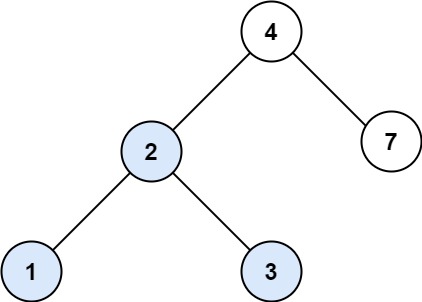
Input: root = [4,2,7,1,3], val = 2
Output: [2,1,3]
Example 2:
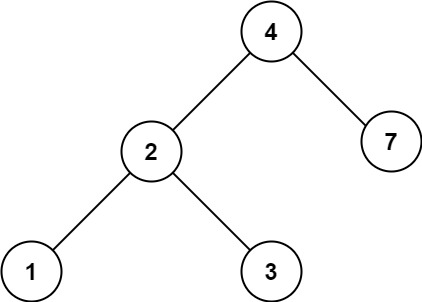
Input: root = [4,2,7,1,3], val = 5
Output: []
Constraints:
- The number of nodes in the tree is in the range
[1, 5000]. 1 <= Node.val <= 107rootis a binary search tree.1 <= val <= 107
Approach 1: Iterative BST Search ( Time, Space)
Intuition
Leverage the fundamental Binary Search Tree property: all values in the left subtree are strictly smaller than root.val, and all values in the right subtree are strictly larger than root.val:
- Traverse down the tree using a pointer
currinitialized toroot. - While
curris notnullandcurr.val != val:- If
val < curr.val, shift to the left child (curr = curr.left). - If
val > curr.val, shift to the right child (curr = curr.right).
- If
- Return
curr(which will either point to the target node ornullif not found).
class Solution {
    public TreeNode searchBST(TreeNode root, int val) {
        TreeNode curr = root;

        while (curr != null && curr.val != val) {
            if (val < curr.val) {
                curr = curr.left;
            } else {
                curr = curr.right;
            }
        }

        return curr;
    }
}
Complexity
- Time Complexity: — Bounded by the height of the BST ( for a balanced tree, worst-case for a skewed tree).
- Space Complexity: — Iterates through pointers using constant auxiliary space.
Approach 2: Recursive DFS ( Time, Space)
Intuition
Express the binary search decisions recursively:
- Base Case: If
root == nullorroot.val == val, returnroot. - Left Branch: If
val < root.val, recursively search the left subtreesearchBST(root.left, val). - Right Branch: If
val > root.val, recursively search the right subtreesearchBST(root.right, val).
class Solution {
    public TreeNode searchBST(TreeNode root, int val) {
        if (root == null || root.val == val) {
            return root;
        }

        return val < root.val ? searchBST(root.left, val) : searchBST(root.right, val);
    }
}
Complexity
- Time Complexity: — Visits at most one node per tree level up to tree height .
- Space Complexity: — Recursion call stack requires space equal to tree height ( balanced, skewed).
Easy Memory Rule
“Target smaller than node? Go Left Target larger than node? Go Right Match or
null? Return Node!”