Description
Convert Sorted Array to Binary Search Tree
Given an integer array nums where the elements are sorted in ascending order, convert it to a height-balanced binary search tree.
Example 1:
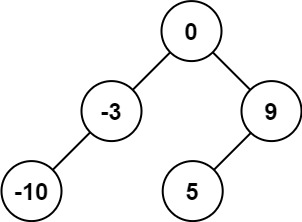
Input: nums = [-10,-3,0,5,9]
Output: [0,-3,9,-10,null,5]
Explanation: [0,-10,5,null,-3,null,9] is also accepted:

Example 2:
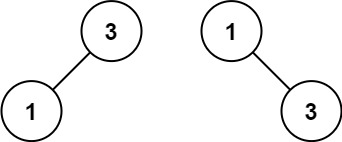
Input: nums = [1,3]
Output: [3,1]
Explanation: [1,null,3] and [3,1] are both height-balanced BSTs.
Constraints:
1 <= nums.length <= 104-104 <= nums[i] <= 104numsis sorted in a strictly increasing order.
Recursive Divide & Conquer ( Time, Space)
Intuition
To construct a height-balanced BST, the middle element of any sorted sub-array must be selected as the root node:
- Calculate
mid = left + (right - left) / 2. - Instantiate
TreeNode(nums[mid])as the root of the current subtree. - Pass index pointers
leftandrightto recursively construct:- Left subtree from index
lefttomid - 1. - Right subtree from index
mid + 1toright.
- Left subtree from index
- Interview Pitch: Avoid using
Arrays.copyOfRange()to slice arrays, as creating sub-arrays at each step adds unnecessary time and memory overhead. Index pointers keep it at optimal time and auxiliary space.
class Solution {
    public TreeNode sortedArrayToBST(int[] nums) {
        return buildBST(nums, 0, nums.length - 1);
    }

    private TreeNode buildBST(int[] nums, int left, int right) {
        if (left > right) return null;

        // Pick the middle element to ensure height balance
        int mid = left + (right - left) / 2;
        TreeNode root = new TreeNode(nums[mid]);

        // Recursively build subtrees using index boundaries
        root.left = buildBST(nums, left, mid - 1);
        root.right = buildBST(nums, mid + 1, right);

        return root;
    }
}
Complexity
- Time Complexity: — Every element in
numsis visited once to instantiate its tree node. - Space Complexity: — The tree is strictly height-balanced, so maximum call stack depth is .
Easy Memory Rule
“Pick
midas Root Passlefttomid - 1for Left Subtree Passmid + 1torightfor Right Subtree!”