You are given an n x n 2D matrix representing an image, rotate the image by 90 degrees (clockwise).
You have to rotate the image in-place, which means you have to modify the input 2D matrix directly. DO NOT allocate another 2D matrix and do the rotation.
Example 1:
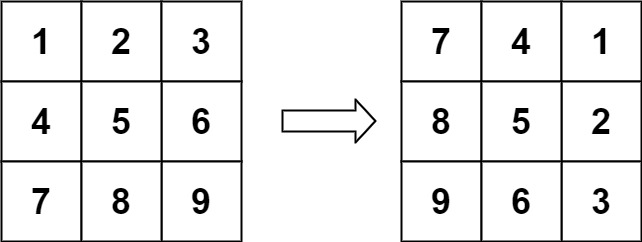
Input: matrix = [[1,2,3],[4,5,6],[7,8,9]]
Output: [[7,4,1],[8,5,2],[9,6,3]]
Example 2:
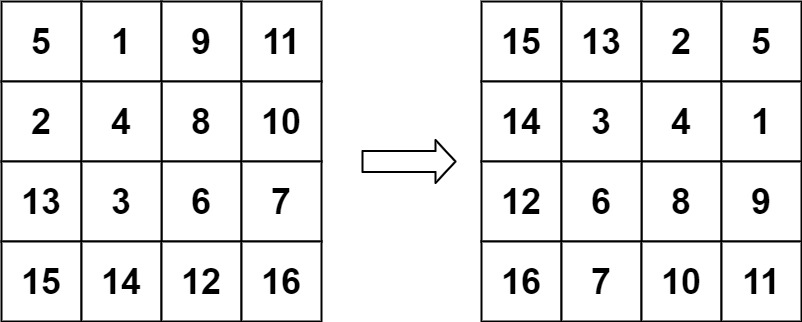
Input: matrix = [[5,1,9,11],[2,4,8,10],[13,3,6,7],[15,14,12,16]]
Output: [[15,13,2,5],[14,3,4,1],[12,6,8,9],[16,7,10,11]]
Constraints:
n == matrix.length == matrix[i].length1 <= n <= 20-1000 <= matrix[i][j] <= 1000
Approach
- We do 2 things first we transpose the matrix then we reverse it to create the rotate image
- first loop goes the way it does because we have to skip the diagonal
- second loop goes this way because we only have to mirror by the diagonal so no only need half
-
⏱ Time Complexity: O(n²)
- Two nested loops over an n×n matrix:
- Transpose: visits each element above the diagonal → ≈ n²/2 swaps
- Reverse: visits half of each row → ≈ n²/2 swaps
- Total work ∝ n².
-
📦 Space Complexity: O(1)
- In-place swaps only; no auxiliary arrays or recursion.
class Solution {
    public void rotate(int[][] matrix) {
        int n = matrix.length;
        // transpose
        for (int i = 0; i < n; i++) {
            for (int j = i + 1; j < n; j++) {
                int t = matrix[i][j];
                matrix[i][j] = matrix[j][i];
                matrix[j][i] = t;
            }
        }

        //reverse
        for(int i = 0; i < n; i++) {
            for (int j = 0; j < n / 2; j++) {
                int t = matrix[i][j];
                matrix[i][j] = matrix[i][n - j - 1];
                matrix[i][n - j - 1] = t;
            }
        }
    }
}