Description
Lowest Common Ancestor of a Binary Tree
Given a binary tree, find the lowest common ancestor (LCA) of two given nodes in the tree.
According to the definition of LCA on Wikipedia: “The lowest common ancestor is defined between two nodes p and q as the lowest node in T that has both p and q as descendants (where we allow a node to be a descendant of itself).”
Example 1:
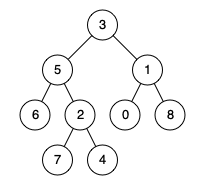
Input: root = [3,5,1,6,2,0,8,null,null,7,4], p = 5, q = 1
Output: 3
Explanation: The LCA of nodes 5 and 1 is 3.
Example 2:
Input: root = [3,5,1,6,2,0,8,null,null,7,4], p = 5, q = 4
Output: 5
Explanation: The LCA of nodes 5 and 4 is 5, since a node can be a descendant of itself according to the LCA definition.
Example 3:
Input: root = [1,2], p = 1, q = 2
Output: 1
Constraints:
- The number of nodes in the tree is in the range
[2, 105]. -109 <= Node.val <= 109- All
Node.valare unique. p != qpandqwill exist in the tree.
Approach 1: Recursive DFS ( Time, Space)
Intuition
Traverse the binary tree using post-order DFS to find the target nodes p and q:
- Base Case: If
root == null,root == p, orroot == q, returnroot. - Recursively search both subtrees:
left = lowestCommonAncestor(root.left, p, q)andright = lowestCommonAncestor(root.right, p, q). - If both
leftandrightreturn non-null,rootis the Lowest Common Ancestor (sincepandqreside in separate subtrees). - If only one subtree returns non-null, pass that non-null node upward (either both targets are in that branch or one target is an ancestor of the other).
class Solution {
    public TreeNode lowestCommonAncestor(TreeNode root, TreeNode p, TreeNode q) {
        if (root == null || root == p || root == q) {
            return root;
        }

        TreeNode left = lowestCommonAncestor(root.left, p, q);
        TreeNode right = lowestCommonAncestor(root.right, p, q);

        // If both left and right return non-null, current root is the LCA
        if (left != null && right != null) {
            return root;
        }

        // Return whichever branch found a node (or null if neither)
        return left != null ? left : right;
    }
}
Complexity
- Time Complexity: — In the worst case, every node in the tree is visited once.
- Space Complexity: — Max call stack size bounded by tree height ( for a balanced tree, for a skewed tree).
Approach 2: Iterative BFS with Parent Mapping ( Time, Space)
Intuition
Uses the standard level-order BFS template (ArrayDeque, queue.offer(), queue.poll()) to build parent pointers until both p and q are discovered:
- Maintain a
Map<TreeNode, TreeNode>to map each child node to its parent. - Run standard BFS starting from
rootuntil bothpandqexist inparentMap. - Traverse up from
ptorootusingparentMap, saving all ofp’s ancestors in aSet<TreeNode>. - Traverse up from
q. The first node encountered that exists inp’s ancestor set is the LCA.
import java.util.ArrayDeque;
import java.util.Deque;
import java.util.HashMap;
import java.util.HashSet;
import java.util.Map;
import java.util.Set;

class Solution {
    public TreeNode lowestCommonAncestor(TreeNode root, TreeNode p, TreeNode q) {
        Map<TreeNode, TreeNode> parentMap = new HashMap<>();
        Deque<TreeNode> queue = new ArrayDeque<>();

        parentMap.put(root, null);
        queue.offer(root);

        // Step 1: BFS to record parents until both p and q are found
        while (!parentMap.containsKey(p) || !parentMap.containsKey(q)) {
            TreeNode curr = queue.poll();

            if (curr.left != null) {
                parentMap.put(curr.left, curr);
                queue.offer(curr.left);
            }
            if (curr.right != null) {
                parentMap.put(curr.right, curr);
                queue.offer(curr.right);
            }
        }

        // Step 2: Collect all ancestors of node p
        Set<TreeNode> ancestors = new HashSet<>();
        TreeNode curr = p;
        while (curr != null) {
            ancestors.add(curr);
            curr = parentMap.get(curr);
        }

        // Step 3: Traverse up from q; first matching ancestor is LCA
        curr = q;
        while (!ancestors.contains(curr)) {
            curr = parentMap.get(curr);
        }

        return curr;
    }
}
Complexity
- Time Complexity: — BFS visits nodes up to
pandq, and ancestor traversal takes at most time. - Space Complexity: — Extra memory needed for the BFS queue,
parentMap, andancestorsset.
Easy Memory Rule
“DFS: If both left and right return non-null
rootis LCA! OR BFS: BuildparentMapusing Queue find first common ancestor!”