Description
662. Maximum Width of Binary Tree
Given the root of a binary tree, return the maximum width of the given tree.
The maximum width of a tree is the maximum width among all levels.
The width of one level is defined as the length between the end-nodes (the leftmost and rightmost non-null nodes), where the null nodes between the end-nodes that would be present in a complete binary tree extending down to that level are also counted into the length calculation.
It is guaranteed that the answer will in the range of a 32-bit signed integer.
Example 1:
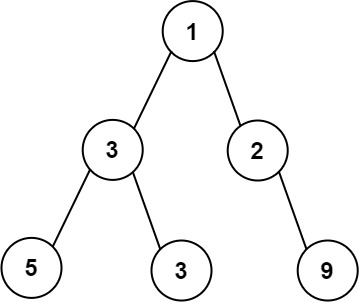
Input: root = [1,3,2,5,3,null,9]
Output: 4
Explanation: The maximum width exists in the third level with length 4 (5,3,null,9).
Example 2:
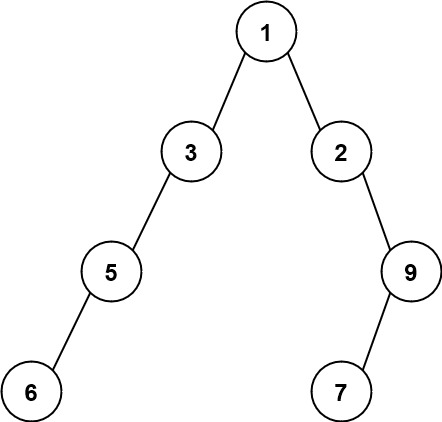
Input: root = [1,3,2,5,null,null,9,6,null,7]
Output: 7
Explanation: The maximum width exists in the fourth level with length 7 (6,null,null,null,null,null,7).
Example 3:
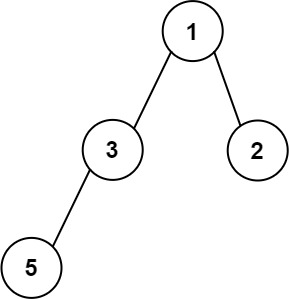
Input: root = [1,3,2,5]
Output: 2
Explanation: The maximum width exists in the second level with length 2 (3,2).
Constraints:
- The number of nodes in the tree is in the range
[1, 3000]. -100 <= Node.val <= 100
Approach 1: BFS Level-Order Traversal with Index Normalization ( Time, Space)
Intuition
Treat the tree as a binary heap where if a parent node is assigned index :
- Left child index
- Right child index
The width of any level is last_index - first_index + 1.
To prevent integer overflow in deep or skewed trees, normalize indices at the start of each level by subtracting the leftmost node’s index (minIndex) before generating child indices.
import java.util.ArrayDeque;
import java.util.Deque;

class Solution {
    private static class Pair {
        TreeNode node;
        int index;

        Pair(TreeNode node, int index) {
            this.node = node;
            this.index = index;
        }
    }

    public int widthOfBinaryTree(TreeNode root) {
        if (root == null) return 0;

        int maxWidth = 0;
        Deque<Pair> queue = new ArrayDeque<>();
        queue.offer(new Pair(root, 0));

        while (!queue.isEmpty()) {
            int size = queue.size();
            int minIndex = queue.peek().index; // Normalize using leftmost index
            int first = 0, last = 0;

            for (int i = 0; i < size; i++) {
                Pair curr = queue.poll();
                int currIndex = curr.index - minIndex; // Prevent integer overflow

                if (i == 0) first = currIndex;
                if (i == size - 1) last = currIndex;

                if (curr.node.left != null) {
                    queue.offer(new Pair(curr.node.left, 2 * currIndex + 1));
                }
                if (curr.node.right != null) {
                    queue.offer(new Pair(curr.node.right, 2 * currIndex + 2));
                }
            }

            maxWidth = Math.max(maxWidth, last - first + 1);
        }

        return maxWidth;
    }
}
Complexity
- Time Complexity: — Each node is pushed and popped from the queue exactly once.
- Space Complexity: — Maximum queue size is bounded by the widest level (up to nodes).
Approach 2: DFS Traversal with Level First-Index Tracking ( Time, Space)
Intuition
Traverse the tree using Depth-First Search while maintaining level and node position index. Keep a list firstIndices where firstIndices.get(level) stores the position index of the first (leftmost) node reached at that level.
For each node:
- If visiting
levelfor the first time (level == firstIndices.size()), record itsindex. - Compute level width using
index - firstIndices.get(level) + 1and updatemaxWidth. - Normalize the index (
index - firstIndex) before making recursive calls to prevent index overflow.
import java.util.ArrayList;
import java.util.List;

class Solution {
    private int maxWidth = 0;

    public int widthOfBinaryTree(TreeNode root) {
        List<Integer> firstIndices = new ArrayList<>();
        dfs(root, 0, 0, firstIndices);
        return maxWidth;
    }

    private void dfs(TreeNode node, int level, int index, List<Integer> firstIndices) {
        if (node == null) return;

        // Record the leftmost node's index at this level
        if (level == firstIndices.size()) {
            firstIndices.add(index);
        }

        int firstIndex = firstIndices.get(level);
        maxWidth = Math.max(maxWidth, index - firstIndex + 1);

        // Normalize index to avoid overflow in deep trees
        int normalizedIndex = index - firstIndex;

        dfs(node.left, level + 1, 2 * normalizedIndex + 1, firstIndices);
        dfs(node.right, level + 1, 2 * normalizedIndex + 2, firstIndices);
    }
}
The main reason for using normalizedIndex is to prevent Integer Overflow (32-bit int overflow) in deep or skewed binary trees.
1. The Problem: Exponential Index Growth
When indexing nodes like a binary heap:
- Left child index
- Right child index
Because child indices double at every level, a right-skewed tree grows exponentially:
- Level 0: Index =
- Level 1: Index =
- Level 2: Index =
- Level 3: Index =
- Level 31: Index exceeds
Integer.MAX_VALUE()
Since the constraints allow up to 3,000 nodes, a tree with a depth of 100 or 1,000 will quickly overflow Java’s 32-bit int into negative numbers, leading to completely incorrect width calculations.
2. Why Normalization Fixes It
We only care about the width of nodes at the same level:
If we subtract the level’s minimum index (firstIndex) from every node at that level:
- **The leftmost node becomes
0**. - The relative distance between nodes stays 100% identical.
- The child indices start back near
0for the next level (), resetting the index growth counter completely!
3. Concrete Example
Suppose at Level 10, the leftmost node has index 1000 and the rightmost node has index 1005:
-
Without Normalization:
-
Width .
-
Children generated for the next level will have huge indices starting around .
-
With Normalization (
currIndex - 1000): -
Leftmost index becomes .
-
Rightmost index becomes .
-
Width (exact same result!).
-
Children generated for the next level start at small indices (), completely avoiding overflow.
Complexity
- Time Complexity: — Every node is visited once during traversal.
- Space Complexity: worst-case recursion stack for a skewed tree ( for a balanced tree), plus space for
firstIndiceswhere is tree height.
Easy Memory Rule
“Assign heap indices (, ) Subtract level min index to avoid overflow Width !”