Given an integer numRows, return the first numRows of Pascal’s triangle.
In Pascal’s triangle, each number is the sum of the two numbers directly above it as shown:
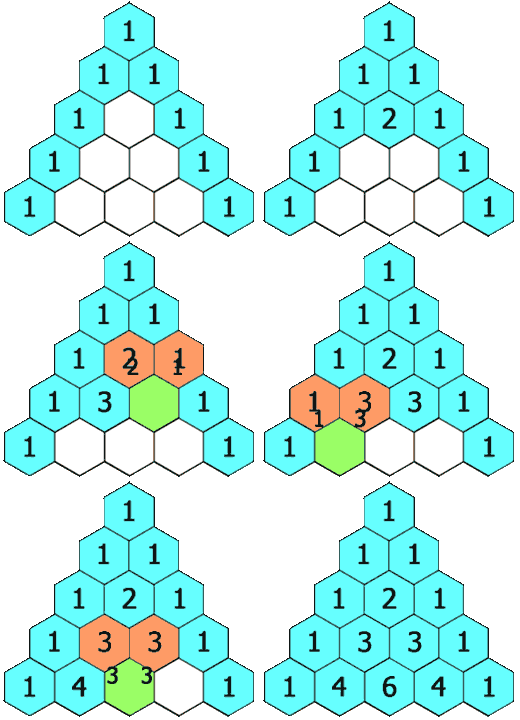
Example 1:
Input: numRows = 5
Output: [[1],[1,1],[1,2,1],[1,3,3,1],[1,4,6,4,1]]
Example 2:
Input: numRows = 1
Output: 1
Constraints:
1 <= numRows <= 30
Approach
- Simple calculate for each row then add
- the addition would be between top left and top
Intuitive Iterative Solution (DP / Standard Approach)
- First and last element will be 1 and for rest use the above formula
- Build the triangle row by row. Each new row is computed directly using the values from the row generated right before it.
- Time Complexity: — You compute every element once.
- Space Complexity: — Required space to store the returned triangle.
import java.util.ArrayList;
import java.util.List;

class Solution {
    public List<List<Integer>> generate(int numRows) {
        List<List<Integer>> triangle = new ArrayList<>();

        for (int i = 0; i < numRows; i++) {
            List<Integer> row = new ArrayList<>();

            for (int j = 0; j <= i; j++) {
                // First and last elements of any row are always 1
                if (j == 0 || j == i) {
                    row.add(1);
                } else {
                    // Sum of two elements directly above in the previous row
                    int val = triangle.get(i - 1).get(j - 1) + triangle.get(i - 1).get(j);
                    row.add(val);
                }
            }

            triangle.add(row);
        }

        return triangle;
    }
}
Combinatoric Row Generation
- Instead of reading from the previous row, you can generate each row independently using the combination formula derived from :
- This avoids looking up previous rows and calculates each value in constant time step-by-step.
- Time Complexity: — Optimal minimum operations required to output all values.
- Space Complexity: auxiliary space (excluding output memory).
import java.util.ArrayList;
import java.util.List;

class Solution {
    public List<List<Integer>> generate(int numRows) {
        List<List<Integer>> triangle = new ArrayList<>();

        for (int i = 0; i < numRows; i++) {
            List<Integer> row = new ArrayList<>();
            long val = 1; // First element of row is always 1
            row.add((int) val);

            for (int j = 1; j <= i; j++) {
                // Compute next element directly: val = val * (i - j + 1) / j
                val = val * (i - j + 1) / j;
                row.add((int) val);
            }

            triangle.add(row);
        }

        return triangle;
    }
}
Why Use long?
We use long for the variable val solely to prevent integer overflow during intermediate multiplication steps.
When computing the combination value:
We must perform the multiplication val * (i - j + 1) before dividing by j. If we divide first, we get truncation errors because integer division drops decimals.
While the final result for any element in a standard 32-bit integer array easily fits inside an int for , the intermediate multiplication product val * (i - j + 1) can briefly exceed Integer.MAX_VALUE () for slightly larger rows before the division scales it back down. Using long guarantees no arithmetic overflow occurs during that intermediate step.
How We Derive the Math Formula
Every element in Pascal’s Triangle corresponds to a combination from probability math:
(Note: row and column are -indexed)
To find the relationship between two consecutive elements in the same row, look at the ratio between and :
-
Write out the consecutive formulas:
-
Divide the Current Element by the Previous Element:
-
Simplify the fraction by canceling common terms (, factorials):
-
Rearrange to get the formula used in code:
Easy Trick to Remember:
-
Numerator: Starts at and decreases by 1 for each step across the row ().
-
Denominator: Counts up step-by-step ().