Given an m x n integer matrix matrix, if an element is 0, set its entire row and column to 0’s.
You must do it in place.
Example 1:
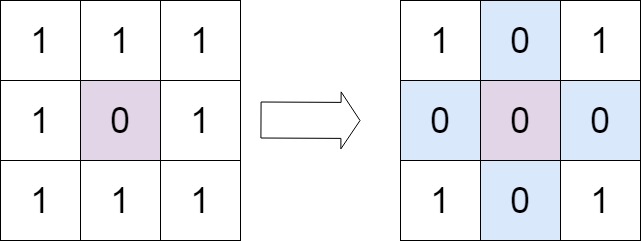
Input: matrix = [[1,1,1],[1,0,1],[1,1,1]]
Output: [[1,0,1],[0,0,0],[1,0,1]]
Example 2:
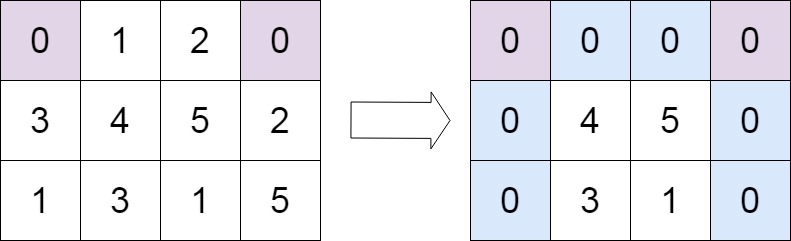
Input: matrix = [[0,1,2,0],[3,4,5,2],[1,3,1,5]]
Output: [[0,0,0,0],[0,4,5,0],[0,3,1,0]]
Constraints:
m == matrix.lengthn == matrix[0].length1 <= m, n <= 200-231 <= matrix[i][j] <= 231 - 1
Follow up:
- A straightforward solution using
O(mn)space is probably a bad idea. - A simple improvement uses
O(m + n)space, but still not the best solution. - Could you devise a constant space solution?
Approach
- If we see any zero then mark the that column and row’s first element as zero this is later used to mark all rows and columns as zeros
- We also need to check for first row and col as all the operation above would be done starting from 1
- Time:
O(m*n)Space:O(1) - First we will check if any of 0th row or column is zero because if it is
class Solution {
    public void setZeroes(int[][] matrix) {
        int row = matrix.length, col = matrix[0].length;
        boolean fr = false, fc = false;
        for (int i = 0; i < row; i++) {
            if (matrix[i][0] == 0)
                fr = true;
        }

        for (int j = 0; j < col; j++) {
            if (matrix[0][j] == 0)
                fc = true;
        }
		// mark row and col starting from 1
        for (int i = 1; i < row; i++) {
            for (int j = 1; j < col; j++) {
                if (matrix[i][j] == 0) {
                    matrix[i][0] = 0;
                    matrix[0][j] = 0;
                }
            }
        }
		//finally make them zero starting from 1
        for (int i = 1; i < row; i++) {
            for (int j = 1; j < col; j++) {
                if (matrix[i][0] == 0 || matrix[0][j] == 0)
                    matrix[i][j] = 0;
            }
        }
		// handle first col and row separately
        if (fr) {
            for (int i = 0; i < row; i++) {
                matrix[i][0] = 0;
            }
        }

        if (fc) {
            for (int i = 0; i < col; i++) {
                matrix[0][i] = 0;
            }
        }
    }
}
💡 The Core Problem and the Strategy
If you change rows and columns to zero immediately while looping through the matrix, you will accidentally overwrite non-zero elements before checking them. You would end up turning the entire matrix into zeros!
To fix this without using extra memory:
- Use variables
frandfcto remember if the very first row/column natively have zeros. - Use the rest of the first row and column as marker flags to store the zero locations for the inner matrix.
- Process the inner matrix first.
- Process the first row and column last.
🚶♂️ Step-by-Step Code Walkthrough
Step 1: Check the First Row and Column
java
boolean fr = false, fc = false;
for (int i = 0; i < row; i++) {
    if (matrix[i][0] == 0) fr = true;
}
for (int j = 0; j < col; j++) {
    if (matrix[0][j] == 0) fc = true;
}
Use code with caution.
- What it does: It checks if there is any
0sitting natively in the 0th column or the 0th row. - Why: We are about to overwrite these cells with our tracking scoreboard, so we need to save their original status in
fr(First Row) andfc(First Column) flags first.
Step 2: Use First Row/Col as a “Scoreboard”
java
for (int i = 1; i < row; i++) {
    for (int j = 1; j < col; j++) {
        if (matrix[i][j] == 0) {
            matrix[i][0] = 0; // Mark the row header
            matrix[0][j] = 0; // Mark the column header
        }
    }
}
Use code with caution.
- What it does: Loops through the inner matrix (starting index 1). If it finds a
0at position(i, j), it goes to the edge of the matrix and setsmatrix[i][0] = 0andmatrix[0][j] = 0. - Analogy: Think of the first row and column as light switches. Finding a zero inside flicks the corresponding row and column switches to “off” (0).
Step 3: Update the Inner Matrix Based on Scoreboard
java
for (int i = 1; i < row; i++) {
    for (int j = 1; j < col; j++) {
        if (matrix[i][0] == 0 || matrix[0][j] == 0)
            matrix[i][j] = 0;
    }
}
Use code with caution.
- What it does: Loops through the inner matrix again. It looks at the header of the current row
matrix[i][0]and columnmatrix[0][j]. If either header is0, it safely turns the current cellmatrix[i][j]into0.
Step 4: Handle the First Row and Column Last
java
if (fr) {
    for (int i = 0; i < row; i++) matrix[i][0] = 0;
}
if (fc) {
    for (int i = 0; i < col; i++) matrix[0][i] = 0;
}
Use code with caution.
- What it does: Finally, it checks the boolean flags we saved in Step 1. If
frwas true, it turns the entire first row to zeros. Iffcwas true, it turns the entire first column to zeros.
📊 Complexity Analysis
- Time Complexity: O(M × N) where M is rows and N is columns. We traverse the matrix a few times, but it is purely linear work.
- Space Complexity: O(1) Auxiliary Space. No extra arrays or hash sets were created. The memory remains constant because we manipulated the input matrix directly.
class Solution {
    public void setZeroes(int[][] matrix) {
        int row = matrix.length;
        int col = matrix[0].length;

        // Trackers to see if the first row or first column contain any native zeros
        boolean firstRowHasZero = false;
        boolean firstColHasZero = false;

        // 1. Scan the FIRST COLUMN (Column 0) downwards across all rows
        for (int i = 0; i < row; i++) {
            if (matrix[i][0] == 0) {
                firstColHasZero = true;
            }
        }

        // 2. Scan the FIRST ROW (Row 0) sideways across all columns
        for (int j = 0; j < col; j++) {
            if (matrix[0][j] == 0) {
                firstRowHasZero = true;
            }
        }

        // 3. Scan the INNER MATRIX (starting at index 1)
        // Use the first row and column headers as a scoreboard
        for (int i = 1; i < row; i++) {
            for (int j = 1; j < col; j++) {
                if (matrix[i][j] == 0) {
                    matrix[i][0] = 0; // Mark the row header
                    matrix[0][j] = 0; // Mark the column header
                }
            }
        }

        // 4. Update the INNER MATRIX based on the scoreboard headers
        for (int i = 1; i < row; i++) {
            for (int j = 1; j < col; j++) {
                if (matrix[i][0] == 0 || matrix[0][j] == 0) {
                    matrix[i][j] = 0;
                }
            }
        }

        // 5. Handle the FIRST COLUMN separately using the tracker variable
        if (firstColHasZero) {
            for (int i = 0; i < row; i++) {
                matrix[i][0] = 0;
            }
        }

        // 6. Handle the FIRST ROW separately using the tracker variable
        if (firstRowHasZero) {
            for (int j = 0; j < col; j++) {
                matrix[0][j] = 0;
            }
        }
    }
}
- Easier one that doesn’t require swap names, this is easy col with col and row with row
class Solution {
    public void setZeroes(int[][] matrix) {
        int row = matrix.length;
        int col = matrix[0].length;

        boolean firstRowZero = false, firstColZero = false;
        for (int i =0; i < row; i++) {
            if (matrix[i][0] == 0)
                firstRowZero = true;
        }
        for (int j = 0; j < col; j++) {
            if (matrix[0][j] == 0)
                firstColZero = true;
        }

        for (int i = 1; i < row; i++) {
            for (int j = 1; j < col; j++) {
                if (matrix[i][j] == 0) {
                    matrix[i][0] = 0;
                    matrix[0][j] = 0;
                }
            }
        }

        for (int i = 1; i < row; i++) {
            for (int j = 1; j < col; j++) {
                if (matrix[i][0] == 0 || matrix[0][j] == 0)
                    matrix[i][j] = 0;
            }
        }

        if (firstRowZero) {
            for (int i = 0; i < row; i++) {
                matrix[i][0] = 0;
            }
        }

        if (firstColZero) {
            for (int j = 0; j < col; j++) {
                matrix[0][j] = 0;
            }
        }
    }
}