You are given an m x n integer array grid. There is a robot initially located at the top-left corner (i.e., grid[0][0]). The robot tries to move to the bottom-right corner (i.e., grid[m - 1][n - 1]). The robot can only move either down or right at any point in time.
An obstacle and space are marked as 1 or 0 respectively in grid. A path that the robot takes cannot include any square that is an obstacle.
Return the number of possible unique paths that the robot can take to reach the bottom-right corner.
The testcases are generated so that the answer will be less than or equal to 2 * 109.
Example 1:
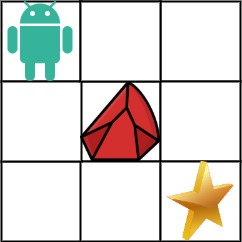
Input: obstacleGrid = [[0,0,0],[0,1,0],[0,0,0]]
Output: 2
Explanation: There is one obstacle in the middle of the 3x3 grid above.
There are two ways to reach the bottom-right corner:
- Right -> Right -> Down -> Down
- Down -> Down -> Right -> Right
Example 2:

Input: obstacleGrid = [[0,1],[0,0]]
Output: 1
Constraints:
m == obstacleGrid.lengthn == obstacleGrid[i].length1 <= m, n <= 100obstacleGrid[i][j]is0or1.
Approach - Bottom Up 1D DP
- Similar to part 1 just need to put
dpas 0 when there is obstacle - What’s stored in
dp[j]?
Before updatingdp[j]:
dp[j]holds the min path sum to reach the cell directly above →grid[i-1][j]
dp[j - 1]holds the min path sum to reach the cell to the left →grid[i][j-1]
class Solution {
    public int uniquePathsWithObstacles(int[][] obstacleGrid) {
        int M = obstacleGrid.length, N = obstacleGrid[0].length;
        int[] dp = new int[N + 1];
        dp[N-1] = 1;

        for (int i = M - 1; i >= 0; i--) {
            for (int j = N - 1; j >= 0; j--) {
                if (obstacleGrid[i][j] == 1)
                    dp[j] = 0;
                else
                    dp[j] += dp[j+1];
            }
        }

        return dp[0];
    }
}