Description
Binary Tree Level Order Traversal
Given the root of a binary tree, return the level order traversal of its nodes’ values. (i.e., from left to right, level by level).
Example 1:
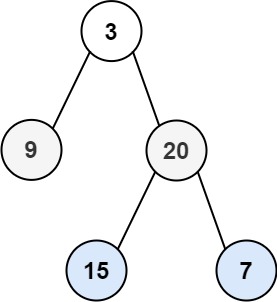
Input: root = [3,9,20,null,null,15,7]
Output: [[3],[9,20],[15,7]]
Example 2:
Input: root = [1]
Output: [[1]]
Example 3:
Input: root = []
Output: []
Constraints:
- The number of nodes in the tree is in the range
[0, 2000]. -1000 <= Node.val <= 1000
Approach
- Make sure we will return empty list for null root while in calculation we cannot add empty list
Time: O(n) Space: O(n)
class Solution {
    public List<List<Integer>> levelOrder(TreeNode root) {
        List<List<Integer>> d = new ArrayList<>();
        if (root == null) return d;
        Queue<TreeNode> q = new LinkedList<>();
        q.add(root);
        while (!q.isEmpty()) {
            List<Integer> l = new ArrayList<>();
            for (int i = q.size(); i > 0; i--) {
                TreeNode n = q.poll();
                l.add(n.val);
                if(n.left != null) q.add(n.left);
                if(n.right != null) q.add(n.right);
            }
            d.add(l);
        }
        return d;
    }
}
class Solution {
public List<List<Integer>> levelOrder(TreeNode root) {
List<List<Integer>> a = new ArrayList<>();
if (root == null) {
return a;
}
Queue<TreeNode> q = new LinkedList<>();
q.add(root);
while (!q.isEmpty()) {
List<Integer> l = new ArrayList<>();
for (int i = q.size(); i > 0; i--) {
TreeNode n = q.poll();
if (n != null) {
l.add(n.val);
q.add(n.left);
q.add(n.right);
}
}
if (l.size() > 0) a.add(l);
}
return a;
}
}Approach 1: BFS Level-Order Traversal ( Time, Space)
Intuition
Use a queue (ArrayDeque) to process the tree level by level:
- At each iteration, capture the current
queue.size()to determine how many nodes belong to the current level. - Poll each node, append its value to a
currentLevelsublist, and push its non-nullleftandrightchildren into the queue. - Append
currentLevelto the mainresultlist before moving to the next level.
import java.util.ArrayDeque;
import java.util.ArrayList;
import java.util.Deque;
import java.util.List;

class Solution {
    public List<List<Integer>> levelOrder(TreeNode root) {
        List<List<Integer>> result = new ArrayList<>();
        if (root == null) return result;

        Deque<TreeNode> queue = new ArrayDeque<>();
        queue.offer(root);

        while (!queue.isEmpty()) {
            int levelSize = queue.size();
            List<Integer> currentLevel = new ArrayList<>();

            for (int i = 0; i < levelSize; i++) {
                TreeNode curr = queue.poll();
                currentLevel.add(curr.val);

                if (curr.left != null) queue.offer(curr.left);
                if (curr.right != null) queue.offer(curr.right);
            }

            result.add(currentLevel);
        }

        return result;
    }
}
Complexity
- Time Complexity: — Every node in the binary tree is processed exactly once.
- Space Complexity: — The queue holds at most nodes at the widest level of a balanced tree.
Approach 2: Recursive DFS Level Tracking ( Time, Space)
Intuition
Traverse the tree using Depth-First Search while passing down the current depth level:
- If
depth == result.size(), it indicates the first arrival at this level, so instantiate and append a newArrayList<Integer>. - Add
node.valto the list at indexdepth(result.get(depth)). - Recursively call
dfsonnode.leftandnode.rightwithdepth + 1.
import java.util.ArrayList;
import java.util.List;

class Solution {
    public List<List<Integer>> levelOrder(TreeNode root) {
        List<List<Integer>> result = new ArrayList<>();
        dfs(root, 0, result);
        return result;
    }

    private void dfs(TreeNode node, int depth, List<List<Integer>> result) {
        if (node == null) return;

        // First time reaching this level -> add a new level list
        if (depth == result.size()) {
            result.add(new ArrayList<>());
        }

        // Add node value to its corresponding level list
        result.get(depth).add(node.val);

        dfs(node.left, depth + 1, result);
        dfs(node.right, depth + 1, result);
    }
}
Complexity
- Time Complexity: — Every node is visited once.
- Space Complexity: worst-case call stack depth for a skewed tree ( for a balanced tree).
Easy Memory Rule
“BFS: Process
queue.size()elements per loop OR DFS: Ifdepth == result.size(), create new sublist and append atdepth!”