Description
Lowest Common Ancestor of a Binary Tree
Given a binary search tree (BST), find the lowest common ancestor (LCA) node of two given nodes in the BST.
According to the definition of LCA on Wikipedia: “The lowest common ancestor is defined between two nodes p and q as the lowest node in T that has both p and q as descendants (where we allow a node to be a descendant of itself).”
Example 1:
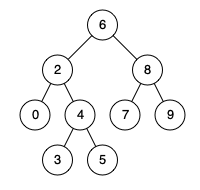
Input: root = [6,2,8,0,4,7,9,null,null,3,5], p = 2, q = 8
Output: 6
Explanation: The LCA of nodes 2 and 8 is 6.
Example 2:
Input: root = [6,2,8,0,4,7,9,null,null,3,5], p = 2, q = 4
Output: 2
Explanation: The LCA of nodes 2 and 4 is 2, since a node can be a descendant of itself according to the LCA definition.
Example 3:
Input: root = [2,1], p = 2, q = 1
Output: 2
Constraints:
- The number of nodes in the tree is in the range
[2, 105]. -109 <= Node.val <= 109- All
Node.valare unique. p != qpandqwill exist in the BST.
Approach - Iterative
- If both the value are less then move left otherwise move right
- Think of all the scenarios not covered in the first 2 blocks that tells you the solutions
- If one is less and other is greater then that is the solutions and if either is equal then that is also
Time: O(h) Space: O(1)
/**
 * Definition for a binary tree node.
 * public class TreeNode {
 *     int val;
 *     TreeNode left;
 *     TreeNode right;
 *     TreeNode(int x) { val = x; }
 * }
 */

class Solution {
    public TreeNode lowestCommonAncestor(TreeNode root, TreeNode p, TreeNode q) {
        TreeNode c = root;
        while (c != null) {
            if (p.val < c.val && q.val < c.val)
                c = c.left;
            else if (p.val > c.val && q.val > c.val)
                c = c.right;
            else
                return c;
        }
        return null;
    }
}
Primary Approach: Iterative BST Search ( Time, Space)
Intuition
Leveraging the BST property (left < root < right), we determine which subtree contains both and without needing to explore both subtrees:
- Start at
curr = root. - If both
p.valandq.valare strictly smaller thancurr.val, the LCA must lie in the left subtree movecurr = curr.left. - If both
p.valandq.valare strictly larger thancurr.val, the LCA must lie in the right subtree movecurr = curr.right. - If one target is on the left and the other is on the right (or
currequals or ), the paths splitcurris the LCA.
class Solution {
    public TreeNode lowestCommonAncestor(TreeNode root, TreeNode p, TreeNode q) {
        TreeNode curr = root;

        while (curr != null) {
            // Both p and q are in the left subtree
            if (p.val < curr.val && q.val < curr.val) {
                curr = curr.left;
            }
            // Both p and q are in the right subtree
            else if (p.val > curr.val && q.val > curr.val) {
                curr = curr.right;
            }
            // Split point found: curr is the LCA
            else {
                return curr;
            }
        }

        return null;
    }
}
Complexity
- Time Complexity: — We traverse down a single path from root to target, where is the tree height ( for balanced, for skewed).
- Space Complexity: — Iterative traversal uses constant auxiliary space.
Alternative Approach: Recursive Search ( Time, Space)
Intuition
Express the single-branch decision logic recursively:
- If both
p.valandq.valare less thanroot.val,recurseonroot.left. - If both
p.valandq.valare greater thanroot.val, recurse onroot.right. - Otherwise, return
root.
class Solution {
    public TreeNode lowestCommonAncestor(TreeNode root, TreeNode p, TreeNode q) {
        // Both p and q lie in the left subtree
        if (p.val < root.val && q.val < root.val) {
            return lowestCommonAncestor(root.left, p, q);
        }

        // Both p and q lie in the right subtree
        if (p.val > root.val && q.val > root.val) {
            return lowestCommonAncestor(root.right, p, q);
        }

        // Split point found: root is the LCA
        return root;
    }
}
Complexity
- Time Complexity: — Visits at most one node per tree level.
- Space Complexity: — Call stack requires space equal to tree height .
Key Interview Discussion Points
- BST vs. Generic Binary Tree: Point out that in a standard Binary Tree (
LeetCode236), you must search both subtrees ( time). For a BST, utilizing the value ordering allows pruning an entire subtree at each step, dropping time to and enabling an space iterative solution. - Overflow Avoidance: Compare conditions explicitly (
p.val < curr.val && q.val < curr.val) rather than using multiplication like(root.val - p.val) * (root.val - q.val) < 0, which can cause integer overflow errors on large values.
Easy Memory Rule
“Both values smaller? Go Left Both values larger? Go Right Otherwise (Split Point)? Return Current Node!”