Description
Balanced Binary Tree
Given a binary tree, determine if it is A height-balanced binary tree is a binary tree in which the depth of the two subtrees of every node never differs by more than one..
Example 1:
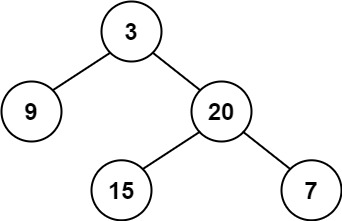
Input: root = [3,9,20,null,null,15,7]
Output: true
Example 2:
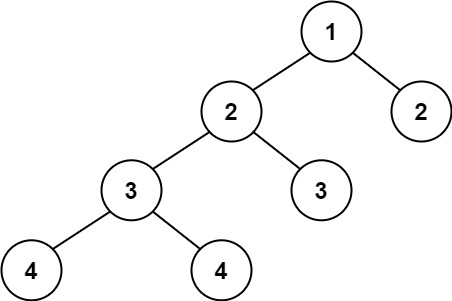
Input: root = [1,2,2,3,3,null,null,4,4]
Output: false
Example 3:
Input: root = []
Output: true
Constraints:
- The number of nodes in the tree is in the range
[0, 5000]. -104 <= Node.val <= 104
Approach
- We will return -1 if it is not balanced and rest is simple dfs recursion
class Solution {
    public boolean isBalanced(TreeNode root) {
        return check(root) != -1;
    }

    public int check(TreeNode root) {
        if (root == null)
            return 0;

        int left = check(root.left);
        int right = check(root.right);

        if (left == -1 || right == -1 || Math.abs(left - right) > 1)
            return -1;

        return 1 + Math.max(left,right);
    }
}
Approach 1: Bottom-Up Recursive DFS ( Time, Space)
Intuition
Calculate the height of left and right subtrees recursively. If any subtree is found to be unbalanced (height difference ), return -1 to immediately short-circuit and propagate the failure upward.
- If node is
null, return height0. - Recursively check
checkHeight(node.left)andcheckHeight(node.right). If either returns-1, return-1. - If
Math.abs(leftHeight - rightHeight) > 1, return-1(unbalanced). - Otherwise, return
1 + Math.max(leftHeight, rightHeight).
class Solution {
    public boolean isBalanced(TreeNode root) {
        return checkHeight(root) != -1;
    }

    private int checkHeight(TreeNode node) {
        if (node == null) return 0;

        int leftHeight = checkHeight(node.left);
        if (leftHeight == -1) return -1; // Short-circuit left subtree

        int rightHeight = checkHeight(node.right);
        if (rightHeight == -1) return -1; // Short-circuit right subtree

        // If height difference exceeds 1, tree is unbalanced
        if (Math.abs(leftHeight - rightHeight) > 1) {
            return -1;
        }

        return 1 + Math.max(leftHeight, rightHeight);
    }
}
Complexity
- Time Complexity: — Every node is visited at most once; short-circuits early on unbalanced subtrees.
- Space Complexity: worst-case call stack depth for a skewed tree ( for a balanced tree).
Approach 2: Iterative Postorder Traversal with Map ( Time, Space)
Intuition
Use the standard single-stack postorder traversal template (lastVisited pointer) while tracking subtree heights in a Map<TreeNode, Integer>.
- Traverse left branches to the leaf nodes.
- When popping a node from the stack (after both child subtrees have been processed), retrieve
leftHeightandrightHeightfromheights. - If
Math.abs(leftHeight - rightHeight) > 1, immediately returnfalse. - Otherwise, store
1 + Math.max(leftHeight, rightHeight)intoheightsfor the current node.
import java.util.ArrayDeque;
import java.util.Deque;
import java.util.HashMap;
import java.util.Map;

class Solution {
    public boolean isBalanced(TreeNode root) {
        if (root == null) return true;

        Deque<TreeNode> stack = new ArrayDeque<>();
        Map<TreeNode, Integer> heights = new HashMap<>();
        TreeNode curr = root;
        TreeNode lastVisited = null;

        while (curr != null || !stack.isEmpty()) {
            while (curr != null) {
                stack.push(curr);
                curr = curr.left;
            }

            TreeNode peekNode = stack.peek();
            if (peekNode.right != null && lastVisited != peekNode.right) {
                curr = peekNode.right;
            } else {
                stack.pop();
                int leftHeight = heights.getOrDefault(peekNode.left, 0);
                int rightHeight = heights.getOrDefault(peekNode.right, 0);

                if (Math.abs(leftHeight - rightHeight) > 1) {
                    return false;
                }

                heights.put(peekNode, 1 + Math.max(leftHeight, rightHeight));
                lastVisited = peekNode;
            }
        }

        return true;
    }
}
Complexity
- Time Complexity: — Every node is pushed, popped, and evaluated in time.
- Space Complexity: — Space required for the explicit stack and the node-to-height map.
Easy Memory Rule
“Calculate node heights bottom-up If
Math.abs(leftHeight - rightHeight) > 1return-1/false!”
Roles of curr and peekNode
curr(The Explorer / Downward Navigator):
Controls the downward traversal phase. As long ascurr != null, it drives the loop to push nodes onto the stack and dive as deep left as possible.peekNode(The Inspector / Parent Checkpoint):
Inspects the node currently at the top of the stack without removing it. It checks whether the node’s right subtree is already processed or still needs to be explored.
Why peek() and NOT pop() Initially?
In Postorder Traversal (), a parent node can only be processed after both its left and right subtrees are completely finished.
When you reach the bottom of a left branch, the top of the stack holds a parent node whose left child was just processed.
- If you
pop()immediately: You permanently remove the parent from the stack. If that parent happens to have a right child that hasn’t been visited yet, you lose your reference to return to this parent later. - Because you
peek()first: You safely inspect the parent node to make a 2-way decision:- Case A (Right subtree pending):
peekNode.right != null && lastVisited != peekNode.right- You keep the parent on the stack and pivot right:
curr = peekNode.right.
- You keep the parent on the stack and pivot right:
- Case B (Both subtrees done):
peekNode.right == nullORlastVisited == peekNode.right- Now it is safe to
pop()! You remove the parent, compute its height using the map, check balance, and updatelastVisited = peekNode.
- Now it is safe to
- Case A (Right subtree pending):
Interview One-Liner Summary
“We
peek()to inspect if the right child needs exploring first. We onlypop()once both left and right subtrees are confirmed finished, satisfying the Postorder () requirement.”