Description
Diameter of Binary Tree
Given the root of a binary tree, return the length of the diameter of the tree.
The diameter of a binary tree is the length of the longest path between any two nodes in a tree. This path may or may not pass through the root.
The length of a path between two nodes is represented by the number of edges between them.
Example 1:
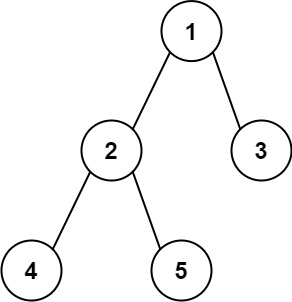
Input: root = [1,2,3,4,5]
Output: 3
Explanation: 3 is the length of the path [4,2,1,3] or [5,2,1,3].
Example 2:
Input: root = [1,2]
Output: 1
Constraints:
- The number of nodes in the tree is in the range
[1, 104]. -100 <= Node.val <= 100
Approach - DFS
class Solution {
    int diameter = 0;
    public int diameterOfBinaryTree(TreeNode root) {
        dfs(root);
        return diameter;
    }

    public int dfs(TreeNode root) {
        if (root == null)
            return 0;

        int left = dfs(root.left);
        int right = dfs(root.right);
        diameter = Math.max(diameter, left + right);
        return 1 + Math.max(left, right);
    }
}
Approach 1: Recursive DFS Height Calculation ( Time, Space)
Intuition
The diameter passing through any given node is the sum of the heights of its left and right subtrees (leftHeight + rightHeight).
- Perform a post-order traversal (
LeftRightRoot) to compute the height of each subtree bottom-up. - At each node, calculate the path length through that node (
leftHeight + rightHeight) and update a global maximum diameter variablemaxDiameter. - Return
1 + Math.max(leftHeight, rightHeight)to pass the node’s height up to its parent.
class Solution {
    private int maxDiameter = 0;

    public int diameterOfBinaryTree(TreeNode root) {
        getHeight(root);
        return maxDiameter;
    }

    private int getHeight(TreeNode node) {
        if (node == null) return 0;

        int leftHeight = getHeight(node.left);
        int rightHeight = getHeight(node.right);

        // Update the maximum diameter found so far
        maxDiameter = Math.max(maxDiameter, leftHeight + rightHeight);

        // Return height of current node
        return 1 + Math.max(leftHeight, rightHeight);
    }
}
Complexity
- Time Complexity: — Visits every node in the binary tree exactly once.
- Space Complexity: worst-case call stack depth for a skewed tree ( for a balanced tree).
Approach 2: Iterative Postorder Traversal with Map ( Time, Space)
Intuition
Use the standard single-stack postorder traversal template (lastVisited pointer) while maintaining a Map<TreeNode, Integer> to store the height of each processed subtree.
- Push left children down to the leaf.
- When popping a node from the stack (after both left and right children have been visited), retrieve
depths.getOrDefault(peekNode.left, 0)anddepths.getOrDefault(peekNode.right, 0). - Update
maxDiameterwithleftHeight + rightHeightand store1 + Math.max(leftHeight, rightHeight)in the map forpeekNode.
import java.util.ArrayDeque;
import java.util.Deque;
import java.util.HashMap;
import java.util.Map;

class Solution {
    public int diameterOfBinaryTree(TreeNode root) {
        if (root == null) return 0;

        int maxDiameter = 0;
        Deque<TreeNode> stack = new ArrayDeque<>();
        Map<TreeNode, Integer> depths = new HashMap<>();
        TreeNode curr = root;
        TreeNode lastVisited = null;

        while (curr != null || !stack.isEmpty()) {
            while (curr != null) {
                stack.push(curr);
                curr = curr.left;
            }

            TreeNode peekNode = stack.peek();
            // If right child exists and hasn't been processed yet, move right
            if (peekNode.right != null && lastVisited != peekNode.right) {
                curr = peekNode.right;
            } else {
                stack.pop();
                int leftHeight = depths.getOrDefault(peekNode.left, 0);
                int rightHeight = depths.getOrDefault(peekNode.right, 0);

                maxDiameter = Math.max(maxDiameter, leftHeight + rightHeight);
                depths.put(peekNode, 1 + Math.max(leftHeight, rightHeight));

                lastVisited = peekNode;
            }
        }

        return maxDiameter;
    }
}
Complexity
- Time Complexity: — Every node is pushed, popped, and stored in the depth map once.
- Space Complexity: — Auxiliary space for the explicit stack and the height
Map.
Easy Memory Rule
“At every node,
diameter = leftHeight + rightHeight. Calculate heights bottom-up using postorder traversal and updatemaxDiameter!”