Description
Maximum Depth of Binary Tree
Given the root of a binary tree, return its maximum depth.
A binary tree’s maximum depth is the number of nodes along the longest path from the root node down to the farthest leaf node.
Example 1:
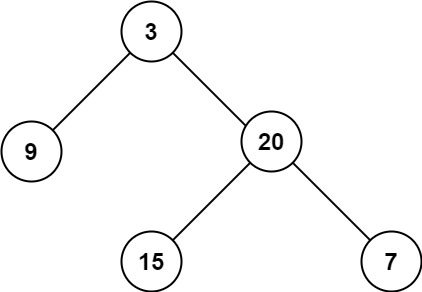
Input: root = [3,9,20,null,null,15,7]
Output: 3
Example 2:
Input: root = [1,null,2] **Output:** 2
Constraints:
- The number of nodes in the tree is in the range
[0, 104]. -100 <= Node.val <= 100
Approach - BFS
- We use queue which uses linked lists, we start by adding the root node then go BFS
- We check how long it takes to reach the end
Time: O(n) Space: O(n)
/**
 * Definition for a binary tree node.
 * public class TreeNode {
 *     int val;
 *     TreeNode left;
 *     TreeNode right;
 *     TreeNode() {}
 *     TreeNode(int val) { this.val = val; }
 *     TreeNode(int val, TreeNode left, TreeNode right) {
 *         this.val = val;
 *         this.left = left;
 *         this.right = right;
 *     }
 * }
 */
class Solution {
    public int maxDepth(TreeNode root) {
        Queue<TreeNode> q = new LinkedList<>();
        if (root != null) q.add(root); //tp kickstart
        int l = 0;
        while (!q.isEmpty()) {
            int size = q.size(); //use this instead direclty in for loop because the queue size will be altered inside the loop
            for (int i = 0; i < size; i++) {
                TreeNode n = q.poll(); // npt only removes but returns
                if (n.left != null) q.add(n.left);
                if (n.right != null) q.add(n.right);
            }
            l++;
        }
        return l;
    }
}
Approach - Recursion
- Time complexity: O(n)
- Space complexity: O(h)
- Best Case (balanced tree): O(log(n))
- Worst Case (degenerate tree): O(n)
/**
 * Definition for a binary tree node.
 * public class TreeNode {
 * int val;
 * TreeNode left;
 * TreeNode right;
 * TreeNode() {}
 * TreeNode(int val) { this.val = val; }
 * TreeNode(int val, TreeNode left, TreeNode right) {
 * this.val = val;
 * this.left = left;
 * this.right = right;
 * }
 * }
 */
class Solution {
    public int maxDepth(TreeNode root) {
        if (root == null)
            return 0;
        return 1 + Math.max(maxDepth(root.left), maxDepth(root.right));
    }
}
Approach 1: Recursive DFS ( Time, Space)
Intuition
The maximum depth of a binary tree is plus the maximum depth between its left and right subtrees.
- If the current node is
null, return (base case). - Recursively calculate the depth of
root.leftandroot.right. - Return
1 + Math.max(leftDepth, rightDepth).
class Solution {
    public int maxDepth(TreeNode root) {
        if (root == null) return 0;

        int leftDepth = maxDepth(root.left);
        int rightDepth = maxDepth(root.right);

        return 1 + Math.max(leftDepth, rightDepth);
    }
}
Complexity
- Time Complexity: — Visits every node in the binary tree exactly once.
- Space Complexity: worst-case call stack depth for a skewed tree ( for a balanced tree).
Approach 2: BFS Level-Order Traversal ( Time, Space)
Intuition
Traverse the tree level by level using a queue (ArrayDeque).
- Add
rootto the queue before the loop. - For each iteration of the
while (!queue.isEmpty())loop, increment adepthcounter. - Process all nodes at the current level (
levelSize = queue.size()) and push their non-null children into the queue. - Return
depthonce the queue is empty.
import java.util.ArrayDeque;
import java.util.Deque;

class Solution {
    public int maxDepth(TreeNode root) {
        if (root == null) return 0;

        Deque<TreeNode> queue = new ArrayDeque<>();
        queue.offer(root);
        int depth = 0;

        while (!queue.isEmpty()) {
            int levelSize = queue.size();
            depth++;

            for (int i = 0; i < levelSize; i++) {
                TreeNode curr = queue.poll();

                if (curr.left != null) queue.offer(curr.left);
                if (curr.right != null) queue.offer(curr.right);
            }
        }

        return depth;
    }
}
Complexity
- Time Complexity: — Every node is offered and polled from the queue once.
- Space Complexity: — Maximum queue size is bounded by the widest level of the tree (up to nodes).
Easy Memory Rule
“DFS:
1 + Math.max(maxDepth(left), maxDepth(right))OR BFS: Incrementdepthonce per level in standard queue loop!”