Description
A path in a binary tree is a sequence of nodes where each pair of adjacent nodes in the sequence has an edge connecting them. A node can only appear in the sequence at most once. Note that the path does not need to pass through the root.
The path sum of a path is the sum of the node’s values in the path.
Given the root of a binary tree, return the maximum path sum of any non-empty path.
Example 1:
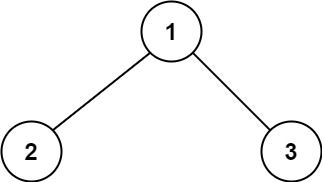
Input: root = [1,2,3]
Output: 6
Explanation: The optimal path is 2 -> 1 -> 3 with a path sum of 2 + 1 + 3 = 6.
Example 2:
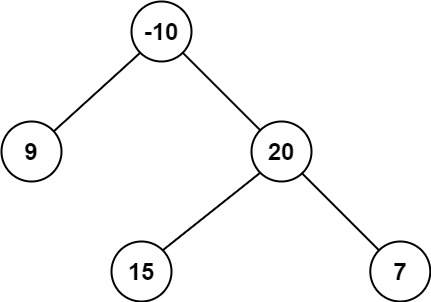
Input: root = [-10,9,20,null,null,15,7]
Output: 42
Explanation: The optimal path is 15 -> 20 -> 7 with a path sum of 15 + 20 + 7 = 42.
Constraints:
- The number of nodes in the tree is in the range
[1, 3 * 104]. -1000 <= Node.val <= 1000
Approach - DFS
- There are three possible answer after we compute left and right, one is left + current + right other is left + current and right + current
Time: O(n) Space: O(h)
class Solution {
    int max = Integer.MIN_VALUE;
    public int maxPathSum(TreeNode root) {
        calculate(root);
        return max;
    }

    public int calculate(TreeNode root) {
        if (root == null)
            return 0;

        int left = Math.max(calculate(root.left),0);
        int right = Math.max(calculate(root.right),0);

        max = Math.max(max, root.val + left + right);
        return root.val + Math.max(left,right);
    }
}
Approach 1: Bottom-Up Recursive DFS ( Time, Space)
Intuition
To find the maximum path sum, treat each node as the potential top-most turning point of a path:
- Recursively calculate the maximum path sum contributed by the left and right subtrees (
maxGain). - If a subtree returns a negative gain, discard it by taking
Math.max(0, gain). - The total path sum centered at the current node is
node.val + leftGain + rightGain. Update the global maximum path summaxSum. - Return
node.val + Math.max(leftGain, rightGain)back to the parent caller, as a path going up to a parent can only extend down one branch (left or right, not both).
class Solution {
    private int maxSum = Integer.MIN_VALUE;

    public int maxPathSum(TreeNode root) {
        maxGain(root);
        return maxSum;
    }

    private int maxGain(TreeNode node) {
        if (node == null) return 0;

        // Ignore negative path gains by clamping to 0
        int leftGain = Math.max(0, maxGain(node.left));
        int rightGain = Math.max(0, maxGain(node.right));

        // Path sum centered at the current node (turning point)
        int currentPathSum = node.val + leftGain + rightGain;
        maxSum = Math.max(maxSum, currentPathSum);

        // Return maximum single-branch gain extending upward to parent
        return node.val + Math.max(leftGain, rightGain);
    }
}
Complexity
- Time Complexity: — Every node is visited exactly once.
- Space Complexity: — Recursion stack size is bounded by the height of the tree ( for balanced trees, for skewed trees).
Approach 2: Iterative Postorder Traversal ( Time, Space)
Intuition
Simulate the bottom-up recursion iteratively using a single-stack postorder traversal (ArrayDeque + lastVisited pointer) along with a Map<TreeNode, Integer> to store each node’s maximum single-branch gain:
- Traverse left down to leaf nodes, pushing nodes onto the stack.
- Peek the stack top (
peekNode). If its right subtree is non-null and unvisited, switch tocurr = peekNode.right. - Otherwise, pop
peekNodeand fetch its children’s gains frommaxGains(clamped to0). - Update global
maxSumwithpeekNode.val + leftGain + rightGain. - Store
peekNode.val + Math.max(leftGain, rightGain)intomaxGainsfor its parent node to use.
import java.util.ArrayDeque;
import java.util.Deque;
import java.util.HashMap;
import java.util.Map;

class Solution {
    public int maxPathSum(TreeNode root) {
        int maxSum = Integer.MIN_VALUE;
        Deque<TreeNode> stack = new ArrayDeque<>();
        Map<TreeNode, Integer> maxGains = new HashMap<>();

        TreeNode curr = root;
        TreeNode lastVisited = null;

        while (curr != null || !stack.isEmpty()) {
            while (curr != null) {
                stack.push(curr);
                curr = curr.left;
            }

            TreeNode peekNode = stack.peek();
            if (peekNode.right != null && lastVisited != peekNode.right) {
                curr = peekNode.right;
            } else {
                stack.pop();

                int leftGain = Math.max(0, maxGains.getOrDefault(peekNode.left, 0));
                int rightGain = Math.max(0, maxGains.getOrDefault(peekNode.right, 0));

                // Path sum where peekNode is the turning point
                int currentPathSum = peekNode.val + leftGain + rightGain;
                maxSum = Math.max(maxSum, currentPathSum);

                // Store max single-branch gain for parent calculations
                maxGains.put(peekNode, peekNode.val + Math.max(leftGain, rightGain));
                lastVisited = peekNode;
            }
        }

        return maxSum;
    }
}
Complexity
- Time Complexity: — Each node is pushed, popped, and processed once.
- Space Complexity: — Requires stack space and map storage for all node gains.
Easy Memory Rule
“At each node: Curved path sum =
val + max(0, left) + max(0, right)Return straight branchval + max(0, max(left, right))!”