Given a binary tree root, a node X in the tree is named good if in the path from root to X there are no nodes with a value greater than X.
Return the number of good nodes in the binary tree.
Example 1:
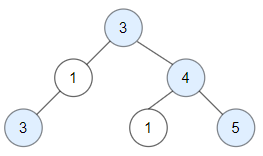
Input: root = [3,1,4,3,null,1,5]
Output: 4
Explanation: Nodes in blue are good.
Root Node (3) is always a good node.
Node 4 -> (3,4) is the maximum value in the path starting from the root.
Node 5 -> (3,4,5) is the maximum value in the path
Node 3 -> (3,1,3) is the maximum value in the path.
Example 2:
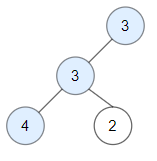
Input: root = [3,3,null,4,2]
Output: 3
Explanation: Node 2 -> (3, 3, 2) is not good, because “3” is higher than it.
Example 3:
Input: root = [1]
Output: 1
Explanation: Root is considered as good.
Constraints:
- The number of nodes in the binary tree is in the range
[1, 10^5]. - Each node’s value is between
[-10^4, 10^4].
Approach - DFS
- We do standard DFS and maintain the max value and if that node value matches condition then assign 1 else 0 then we can just traverse left and right
class Solution {
    public int goodNodes(TreeNode root) {
        return dfs(root, root.val);
    }

    public int dfs(TreeNode root, int max) {
        if (root == null)
            return 0;

        int res = (root.val >= max) ? 1 : 0;
        max = Math.max(max,root.val);
        res += dfs(root.left,max);
        res += dfs(root.right,max);
        return res;
    }
}