Given the root of a binary tree, invert the tree, and return its root.
Example 1:
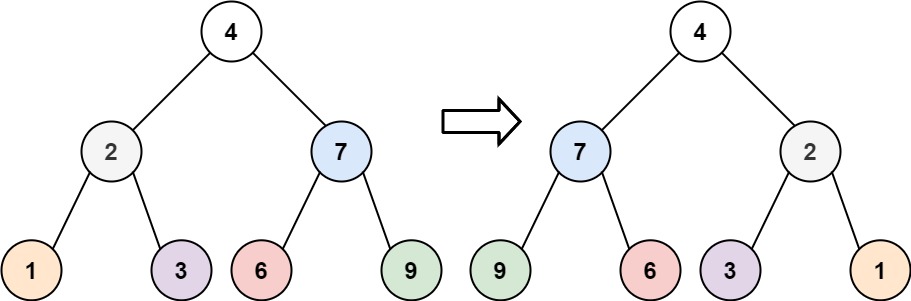
Input: root = [4,2,7,1,3,6,9]
Output: [4,7,2,9,6,3,1]
Example 2:
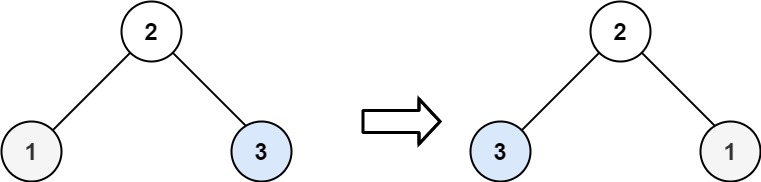
Input: root = [2,1,3]
Output: [2,3,1]
Example 3:
Input: root = []
Output: []
Constraints:
- The number of nodes in the tree is in the range
[0, 100]. -100 <= Node.val <= 100
Approach - Recursion
Time: O(n) Space: O(n)
class Solution {
    public TreeNode invertTree(TreeNode root) {
        if (root == null)
            return null;
        TreeNode t = root.right;
        root.right = root.left;
        root.left = t;
        invertTree(root.left);
        invertTree(root.right);
        return root;
    }
}
Approach - BFS
- We will BFS and use the simple reverse logic
- For loop exist to check for one level so it is required here but might not be required in other solutions
Time: O(n) Space: O(n)
/**
 * Definition for a binary tree node.
 * public class TreeNode {
 *     int val;
 *     TreeNode left;
 *     TreeNode right;
 *     TreeNode() {}
 *     TreeNode(int val) { this.val = val; }
 *     TreeNode(int val, TreeNode left, TreeNode right) {
 *         this.val = val;
 *         this.left = left;
 *         this.right = right;
 *     }
 * }
 */
class Solution {
    public TreeNode invertTree(TreeNode root) {
        if (root == null) return null;
        Queue<TreeNode> q = new LinkedList<>();
        q.add(root);
        while(!q.isEmpty()) {
            TreeNode n = q.poll();
            TreeNode t = n.left;
            n.left = n.right;
            n.right = t;
            if (n.left != null) q.add(n.left);
            if (n.right != null) q.add(n.right);
        }
        return root;
    }
}