Description
Reverse Nodes in k-Group
Given the head of a linked list, reverse the nodes of the list k at a time, and return the modified list.
k is a positive integer and is less than or equal to the length of the linked list. If the number of nodes is not a multiple of k then left-out nodes, in the end, should remain as it is.
You may not alter the values in the list’s nodes, only nodes themselves may be changed.
Example 1:
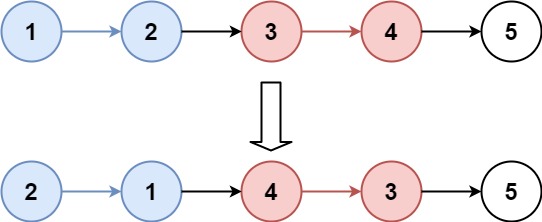
Input: head = [1,2,3,4,5], k = 2
Output: [2,1,4,3,5]
Example 2:
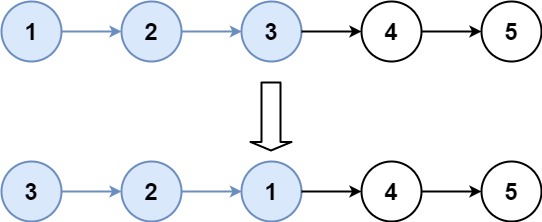
Input: head = [1,2,3,4,5], k = 3
Output: [3,2,1,4,5]
Constraints:
- The number of nodes in the list is
n. 1 <= k <= n <= 50000 <= Node.val <= 1000
Follow-up: Can you solve the problem in O(1) extra memory space?
Approach
- Create a simple method to fetch the kth element from the head provided and create a dummy
- Loop with exit condition as the kth method is null
- Perform a simple reversal but keep in mind the value of previous and current just think of first iteration and what their values should be
- Lastly we have to maintain the previous group tail now and link kth element with the older one
Time:O(n) Space:O(1)- Simply iterating the linked list
/**
 * Definition for singly-linked list.
 * public class ListNode {
 *     int val;
 *     ListNode next;
 *     ListNode() {}
 *     ListNode(int val) { this.val = val; }
 *     ListNode(int val, ListNode next) { this.val = val; this.next = next; }
 * }
 */
class Solution {
    public ListNode getkth(ListNode list, int k) {
        while (list != null && k > 0) {
            list = list.next;
            k--;
        }
        return list;
    }

    public ListNode reverseKGroup(ListNode head, int k) {
        ListNode dummy = new ListNode(0, head);
        ListNode prevGroup = dummy;

        while (true) {
            ListNode kth = getkth(prevGroup, k);
            if (kth == null)
                break;

            ListNode nextGroup = kth.next;
            ListNode prev = kth.next;
            ListNode curr = prevGroup.next;

            while (curr != nextGroup) {
                ListNode tmp = curr.next;
                curr.next = prev;
                prev = curr;
                curr = tmp;
            }

            ListNode tmp = prevGroup.next;
            prevGroup.next = kth;
            prevGroup = tmp;
        }

        return dummy.next;
    }
}
Brute Force: Array / List Conversion
Extract all nodes into an array list, reverse groups of size in the array, and then re-link the pointers.
Intuition: “Dump to List Reverse sub-lists of size Re-link pointers.”
class Solution {
    public ListNode reverseKGroup(ListNode head, int k) {
        List<ListNode> nodes = new ArrayList<>();
        ListNode curr = head;
        while (curr != null) {
            nodes.add(curr);
            curr = curr.next;
        }

        int n = nodes.size();
        for (int i = 0; i + k <= n; i += k) {
            int left = i, right = i + k - 1;
            while (left < right) {
                ListNode temp = nodes.get(left);
                nodes.set(left, nodes.get(right));
                nodes.set(right, temp);
                left++;
                right--;
            }
        }

        // Reconnect all nodes sequentially
        for (int i = 0; i < n - 1; i++) {
            nodes.get(i).next = nodes.get(i + 1);
        }
        if (n > 0) nodes.get(n - 1).next = null;

        return nodes.isEmpty() ? null : nodes.get(0);
    }
}
- Time Complexity: — One pass to collect nodes, one pass to swap pointers.
- Space Complexity: — Stores all nodes in an array list.
Most Optimized: In-Place Iterative Reversal
Iterate through the list and reverse each group of nodes in-place using a dummy node.
Mental Model (3 Steps Per Loop):
- Check: Find the -th node ahead. If less than nodes remain, stop.
- Reverse: Reverse the nodes standardly, setting the tail’s
nexttogroupNext. - Reconnect: Re-link the previous group’s tail to the new group head, and update
groupPrevto the group’s new tail.
class Solution {
    public ListNode reverseKGroup(ListNode head, int k) {
        ListNode dummy = new ListNode(0,head);
        ListNode groupPrev = dummy;

        while (true) {
            ListNode kth = getKth(groupPrev, k);
            if (kth == null) break;

            ListNode groupNext = kth.next;

            // Step 2: Reverse group nodes in-place
            ListNode prev = groupNext;
            ListNode curr = groupPrev.next;
            while (curr != groupNext) {
                ListNode tmp = curr.next;
                curr.next = prev;
                prev = curr;
                curr = tmp;
            }

            // Step 3: Reconnect groupPrev to new head (kth)
            ListNode newTail = groupPrev.next;
            groupPrev.next = kth;
            groupPrev = newTail;
        }

        return dummy.next;
    }

    private ListNode getKth(ListNode curr, int k) {
        while (curr != null && k > 0) {
            curr = curr.next;
            k--;
        }
        return curr;
    }
}
- Time Complexity: — Every node is visited twice (once to count , once to reverse).
- Space Complexity: — Uses constant extra memory space.