You are given an m x n binary matrix grid. An island is a group of 1’s (representing land) connected 4-directionally (horizontal or vertical.) You may assume all four edges of the grid are surrounded by water.
The area of an island is the number of cells with a value 1 in the island.
Return the maximum area of an island in grid. If there is no island, return 0.
Example 1:
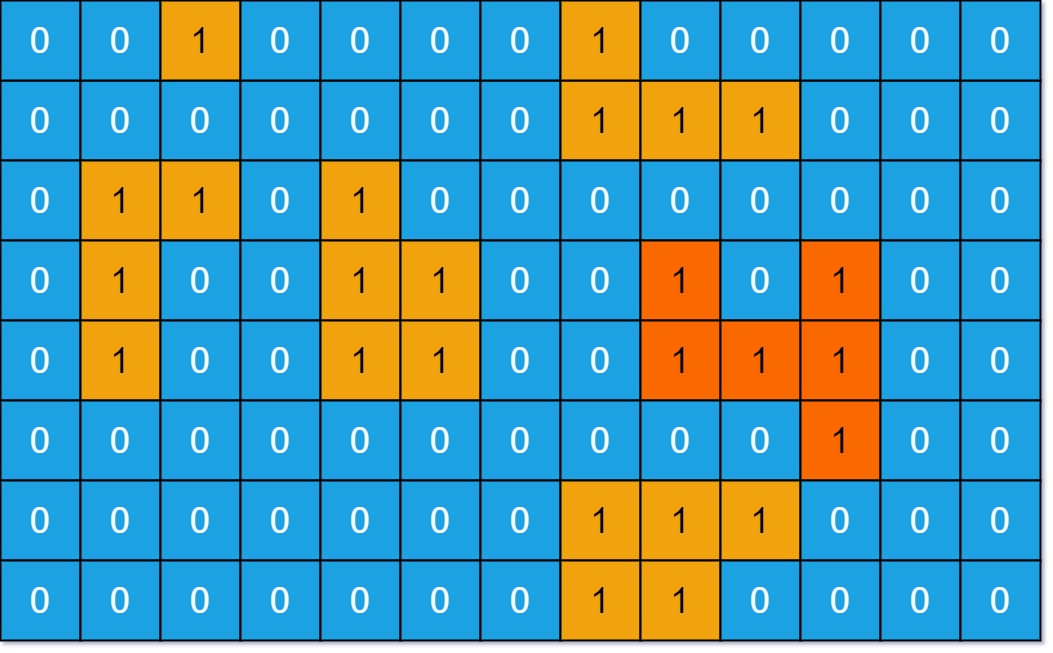
Input: grid = [[0,0,1,0,0,0,0,1,0,0,0,0,0],[0,0,0,0,0,0,0,1,1,1,0,0,0],[0,1,1,0,1,0,0,0,0,0,0,0,0],[0,1,0,0,1,1,0,0,1,0,1,0,0],[0,1,0,0,1,1,0,0,1,1,1,0,0],[0,0,0,0,0,0,0,0,0,0,1,0,0],[0,0,0,0,0,0,0,1,1,1,0,0,0],[0,0,0,0,0,0,0,1,1,0,0,0,0]]
Output: 6
Explanation: The answer is not 11, because the island must be connected 4-directionally.
Example 2:
Input: grid = [[0,0,0,0,0,0,0,0]]
Output: 0
Constraints:
m == grid.lengthn == grid[i].length1 <= m, n <= 50grid[i][j]is either0or1.
Approach
- Same as 1. Number of Islands just need to calculate area as well
- Time complexity:
O(m∗n)O(m∗n) - Space complexity:
O(m∗n)O(m∗n)
class Solution {
    private int[][] dir = new int[][]{{0,1},{1,0},{-1,0},{0,-1}};
    public int maxAreaOfIsland(int[][] grid) {
        int row = grid.length, col = grid[0].length, area = 0;
        for (int i = 0; i < row ; i++) {
            for (int j = 0; j< col; j++) {
                area = Math.max(area, dfs(grid,i,j));
            }
        }
        return area;
    }

    public int dfs(int[][] grid, int r, int c) {
        if (r < 0 || c < 0 || r >= grid.length || c >= grid[0].length || grid[r][c] == 0)
            return 0;

        grid[r][c] = 0;
        int res = 1;
        for (int[] d : dir) {
            res += dfs(grid,r+d[0],c+d[1]);
        }
        return res;
    }
}